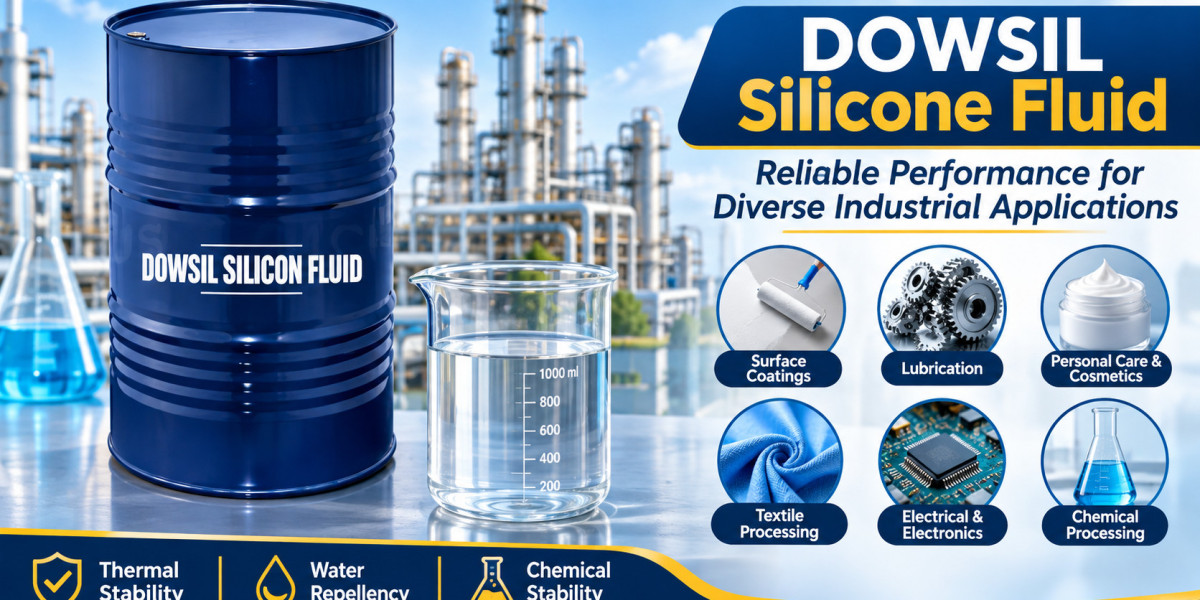

Industrial chemical selection involves more than comparing product prices or availability. Manufacturers must consider technical performance, compatibility, operating conditions, and long-term consistency before incorporating a material into their production process. Silicone fluids are widely evaluated for applications where surface properties, lubrication, water repellency, and thermal performance are important.
Dowsil silicone fluid offers a range of characteristics that make it relevant to industrial formulations, specialty coatings, personal care products, and engineering applications. Understanding these properties helps procurement professionals and formulators make informed decisions when selecting a suitable grade.
Understanding the Role of Dowsil Silicone Fluid
Dowsil silicone fluid refers to silicone-based materials developed for specific performance requirements. Depending on the grade and chemical composition, these fluids may provide lubrication, surface conditioning, spreading, release properties, and water repellency.
Silicone fluids are particularly valuable because their performance characteristics differ from those of conventional mineral oils and other organic liquids. However, not every silicone fluid is interchangeable. Product specifications, viscosity, and compatibility determine whether a particular grade is appropriate for a given application.
Businesses sourcing Dowsil Silicone Fluid should begin by identifying the functional requirement of the material and reviewing the relevant technical documentation.
Key Properties That Influence Material Selection
Thermal Performance
Selected silicone fluids are suitable for applications involving temperature variations. Their physical properties may remain relatively stable across a broad temperature range compared with certain conventional fluids.
Nevertheless, operating limits depend on the individual grade and application. Buyers should review temperature-related data before using a silicone fluid in heating systems, mechanical equipment, or specialized formulations.
Water Repellency
Water-repellent characteristics make silicone fluids useful in selected surface treatments and protective formulations. Depending on the grade, they can help support moisture-resistant surface performance.
The final result depends on substrate characteristics, formulation composition, and application method.
Low Surface Tension
Silicone fluids are known for their relatively low surface tension. This characteristic can promote spreading across compatible surfaces and contribute to smooth finishes in coatings, polish formulations, and specialty products.
Electrical Insulation
Certain silicone fluid grades provide useful dielectric properties. These materials may be considered for electrical applications where insulation characteristics are important. Technical specifications and application testing should guide the selection process.
Chemical Compatibility
Silicone fluids can offer chemical stability under suitable conditions. However, compatibility with solvents, plastics, elastomers, and formulation ingredients must be checked before introducing the fluid into a production system.
Where Dowsil Silicone Fluid Is Used
The versatility of silicone-based materials supports their use across several manufacturing sectors.
Personal Care and Cosmetics
Selected silicone fluids are incorporated into creams, lotions, deodorants, antiperspirants, and hair-care formulations. Their spreading properties and smooth feel can contribute to product texture and application characteristics.
Cosmetic formulators should select grades according to ingredient specifications, applicable regulations, and formulation compatibility.
Industrial Coatings and Surface Treatments
Silicone fluids may be used in compatible coatings, surface treatments, and polish formulations. They can help improve spreading, surface smoothness, and water-repellent characteristics.
The appropriate grade depends on the coating system, substrate, and desired finish.
Textile Processing
Silicone-based materials are used in selected textile finishing applications to support fabric softness, smoothness, and handling. Specialty silicone fluids may also serve as components in textile processing formulations.
Manufacturers should evaluate the material according to fabric type, processing conditions, and finishing requirements.
Mechanical and Engineering Applications
Certain silicone fluids are considered for lubrication, damping, and specialized mechanical applications. Viscosity and temperature performance are especially important when evaluating materials for these uses.
Electrical and Electronic Applications
Selected grades may be suitable for applications requiring electrical insulation or specialized surface characteristics. Buyers should confirm the precise grade specification and test performance under intended operating conditions.
How to Select the Appropriate Grade
Choosing a suitable silicone fluid requires a systematic evaluation of application requirements.
1. Identify the application: Determine whether the material is required for lubrication, coating, surface treatment, personal care, or another purpose.
2. Evaluate viscosity: Viscosity influences flow, spreading, lubrication, and processing behavior. Select a grade according to the required performance rather than assuming a higher or lower viscosity is automatically better.
3. Review operating conditions: Consider temperature, equipment requirements, exposure, and processing methods.
4. Check compatibility: Conduct preliminary testing with the substrate, additives, solvents, and other ingredients.
5. Examine documentation: Request the relevant technical data sheet (TDS) and safety data sheet (SDS). Verify the product identity, specifications, and handling recommendations.
6. Conduct application testing: A controlled trial can help identify formulation or process issues before large-scale production.
This approach reduces uncertainty and supports more consistent material selection.
What to Look for in Dowsil Silicone Fluid Manufacturers
Industrial procurement teams should evaluate suppliers based on product documentation, sourcing transparency, consistency, communication, and availability.
When comparing Dowsil Silicone Fluid Manufacturers, buyers should clarify the supplier's role in the supply chain and confirm whether the material is sourced through an authorized or established distribution channel.
For businesses searching for Dowsil Silicone Fluid Manufacturers in India, reliable documentation and responsive communication are important considerations for domestic purchasing and ongoing industrial supply.
Procurement professionals should also discuss packaging, quantity requirements, storage conditions, and repeat-order availability before finalizing a purchase.
Silicone Fluid Sourcing with Plustech Chem
Plustech Chem supports industrial and commercial buyers looking for silicone-based materials for different applications. Businesses can explore product information and enquire about suitable options according to their technical and procurement requirements.
Visit the Dowsil Silicone Fluid product page to learn more about the available range.
For additional product requirements, explore Silicone Fluid, Silicone Oil, Silicone Emulsion, and Silicone Defoamer.
Conclusion
Dowsil silicone fluid can support a variety of industrial and specialty applications through its grade-dependent properties, including low surface tension, water repellency, lubrication potential, and thermal performance.
Successful selection requires evaluating viscosity, operating conditions, chemical compatibility, and technical documentation. Industrial buyers should also consider sourcing reliability and product consistency when choosing a supplier.
By understanding application requirements and reviewing the appropriate specifications, manufacturers can make more informed procurement decisions. Plustech Chem provides an opportunity for businesses to explore silicone fluid options and enquire about products suited to their requirements.